We Went to Albany for Sunshine Week. Here’s What Happened — and What Still Needs to Change.
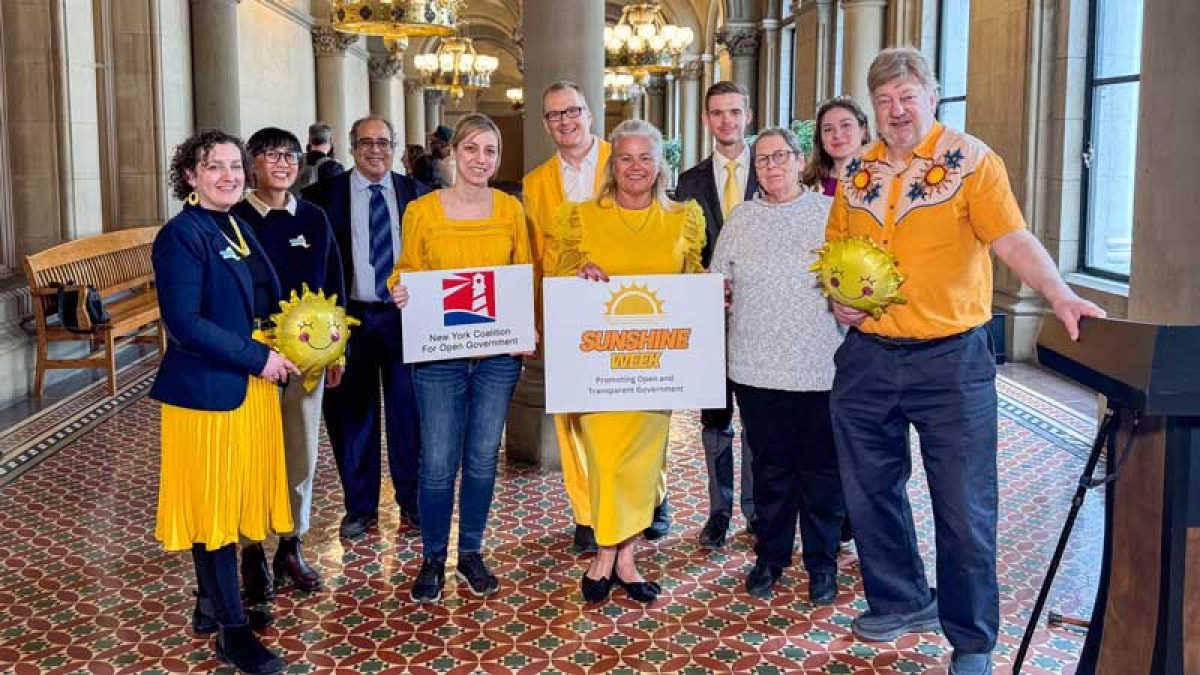
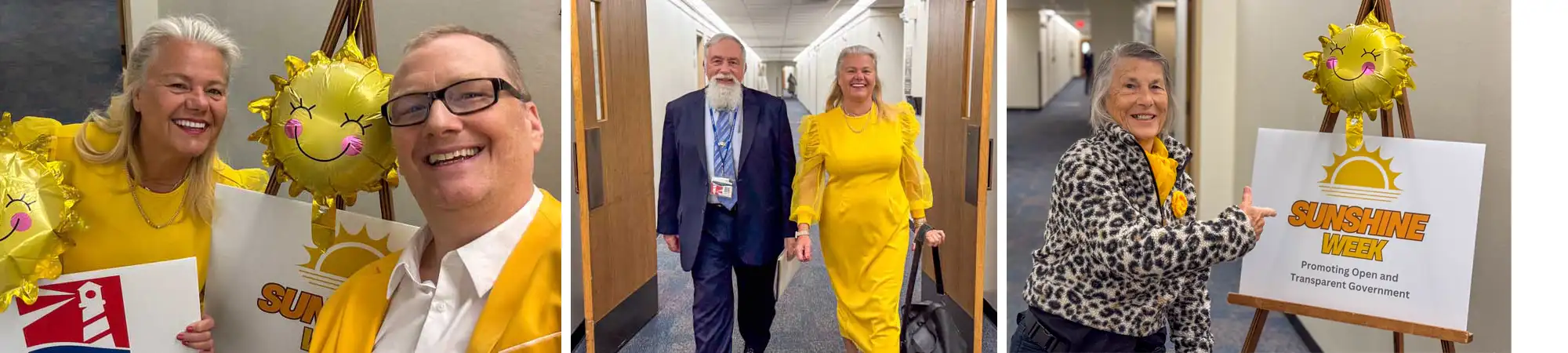
On March 18, our volunteers from across New York State descended on the State Capitol in Albany to do something their government should be doing on its own: demand that the state’s transparency laws actually get enforced.
The press conference, held in the Fourth-Floor Lobby outside the Senate Chambers, marked the New York Coalition for Open Government’s annual Sunshine Week visit. Members traveled on their own time and at their own expense. They were joined by six legislative sponsors and a coalition of 14 transparency organizations — including Reinvent Albany, the NYCLU, Common Cause/NY, the Freedom of the Press Foundation, Legal Aid Society, and others — all calling for passage of four open government reform bills.
The Problem Has Not Changed
New York has a Freedom of Information Law. It has an Open Meetings Law. On paper, these are meaningful protections. In practice, they are being ignored — at every level of government, every single day.
The numbers tell the story. NYCOG’s research shows that 72% of towns do not post meeting documents online. 35% of villages didn’t even post a meeting agenda. 39% of counties failed to acknowledge FOIL requests within the required five business days. 73% of election boards failed to meet that same basic deadline. And 28% of counties never acknowledged requests at all.
Most state agencies take longer than the 20 days required by law to respond to FOIL requests. Only 31% provided FOIL data in their 2022 Transparency Plans.
These are not edge cases. This is the norm. And there is no enforcement mechanism to change it.
Four Bills That Would Make a Difference
The coalition is pushing the Legislature to pass four practical, widely supported reforms:
Constitutional Amendment: Right to Public Information (A834 / S2512) — Sponsored by Assemblymember Phil Steck and Senator Rachel May. California, Florida, Louisiana, and Montana have already written open government into their state constitutions. This amendment would do the same for New York — making the right to access government records and attend public meetings a fundamental right that cannot be quietly eroded by future legislatures or administrations.
Strengthen FOIL Attorney’s Fees (A950A / S1418A) — Sponsored by Assemblymember Phil Steck and Senator John Liu. Agencies know that most people cannot afford to sue. Even when a New Yorker wins a FOIL case in court, recovering legal fees is an uphill battle because of a vague “substantially prevailed” standard. This bill brings New York in line with California and Florida, where you simply need to show you prevailed.
Mandatory Open Government Training for Local Officials (A7552) — Sponsored by Assemblymember Karen McMahon. Senate sponsor urgently needed. Too many local officials are violating FOIL and the Open Meetings Law because nobody ever trained them on what the law requires. This bill mandates two hours of annual training for local clerks, records access officers, and FOIL appeal officers. Other states require this. New York does not.
Require Hybrid Meetings for All Public Bodies (A3615 / S1027) — Sponsored by Assemblymember Tony Simone and Senator Rachel May. New York has been extending temporary hybrid meeting rules year after year since 2022. This bill makes them permanent and mandatory. Every public body would be required to offer remote access so that residents who work nights, care for a child, have a disability, or live far from the meeting room can still participate.
Momentum — and a Governor Who Keeps Blocking It
Six legislative sponsors joined the press conference: Senator John C. Liu, Senator James Skoufis, Assemblymember John T. McDonald III, Assemblymember Steven Raga, Assemblymember Linda B. Rosenthal, and Assemblymember Phil Steck.
There is real momentum behind these reforms. Last session, the bill to reduce agency FOIL response times (S2520 / A3425) passed both the Senate and the Assembly — only to be vetoed by Governor Hochul. Other FOIL reform bills passed one chamber but stalled in the other. The Legislature has shown it is ready to act. The remaining obstacle is political will at the executive level.
As NYCOG’s Axel Ebermann put it during the press conference: “We come to Albany every year with our partners. We research problems, write bills, and work to pass them. Some of them actually move forward thanks to our legislators. And then — they often get vetoed by the governor. That is immensely frustrating.”
A Broad Coalition Is Behind This
The push for reform is backed by Reinvent Albany, Amnesty International USA, BetaNYC, Common Cause/NY, Earthjustice, Freedom of the Press Foundation, Legal Aid Society, The Media and Democracy Project, National Press Club Journalism Institute, New York Civil Liberties Union, New York Public Interest Research Group, Radio Television Digital News Association, and the Surveillance Technology Oversight Project (S.T.O.P.).
What Comes Next
NYCOG urges the Senate and Assembly to pass all four bills during the 2026 legislative session — and calls on the Governor to sign them into law.
New York was the last state in the nation to adopt an Open Meetings Law. We are still one of the weakest states on transparency in the country. That is a choice, not an inevitability. These four bills are a starting point. The Legislature has the votes. The coalition is in place. The only question is whether Albany will act — or make us come back again next year.
We’ll be here either way.
You can watch the press conference here