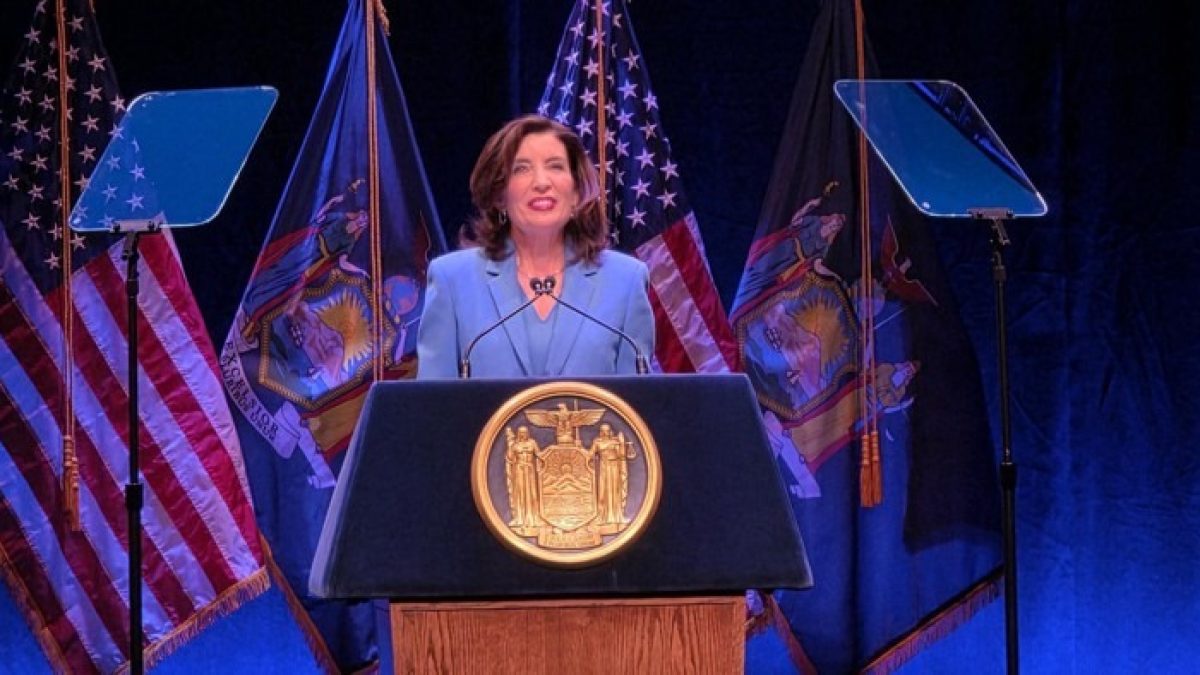
Governor Kathy Hochul’s 2026 State of the State address devoted considerable attention to affordability, public safety, and economic development. What it did not address, once again, is the growing breakdown of government transparency and accountability in New York State.
When Governor Hochul took office in 2021, she pledged a “new era of transparency.” Five years later, that promise remains unmet.
In practice, New York’s Freedom of Information Law (FOIL) and Open Meetings Law (OML) are routinely ignored, delayed, or exploited – without consequence. The result is a system where access to public information exists largely on paper, while real-world compliance continues to deteriorate.
A Transparency System With No Enforcement
New York still lacks any statewide mechanism to track or enforce compliance with its open government laws. No agency is responsible for monitoring whether records are produced on time, meetings are properly noticed, or executive sessions comply with the law.
Volunteer research conducted by the New York Coalition for Open Government continues to show widespread non-compliance at the local level, including missing agendas, absent minutes, unlawful executive sessions, and routine FOIL delays. These are not isolated lapses, they are systemic failures that deny residents the ability to understand, evaluate, or challenge government decisions.
Even the state’s own Committee on Open Government has repeatedly acknowledged these problems, reporting widespread public frustration with delayed FOIL responses, inconsistent compliance, and the limited effectiveness of existing enforcement mechanisms.
2025 Was a Year of Retreat, Not Reform
While the Governor’s address highlighted progress in other policy areas, 2025 marked a significant step backward for transparency and public oversight.
Most notably, Governor Hochul vetoed both FOIL reform bills passed by the Legislature – legislation that would have modestly improved response times and clarified agencies’ redaction obligations. These bills were supported by transparency advocates and, in one case, drafted with input from the Committee on Open Government itself.
S2520-B (Skoufis) / A3425 (Raga)
Reduces time the public must wait to appeal FOIL delays and denials.
Vetoed by Governor
S67 (Skoufis) / A6613 (McDonald)
Clarifies FOIL regarding redactions.
Vetoed by Governor
At the same time, investigative reporting documented that New York remains among the slowest states in the nation for fulfilling public records requests, with some agencies taking months, or even years, to respond. The gap between the Governor’s stated commitment to transparency and the lived experience of journalists, advocates, and residents has only widened.
Beyond FOIL, the Governor also vetoed legislation designed to strengthen New York’s LLC Transparency Act, effectively hollowing out a law meant to combat money laundering, corruption, and anonymous shell companies.
Watchdog organizations warned that the veto rendered the statute largely symbolic, concerns later confirmed by state guidance limiting disclosure requirements to a tiny fraction of entities.
Taken together, these actions reflect a pattern: transparency is repeatedly deprioritized when it conflicts with administrative convenience or political risk.
New York Lags Behind – By Choice
New York was the last state in the nation to adopt an Open Meetings Law. Today, it remains one of the weakest transparency frameworks in the country.
Unlike many states, New York provides:
• No independent enforcement body for FOIL or OML violations
• No guaranteed right for the public to speak at meetings of elected bodies
• No requirement that most local governments livestream or record meetings
• No accessible, low-cost avenue for resolving transparency disputes outside of court. Instead, residents are forced into expensive and time-consuming litigation simply to enforce rights that already exist under the law.
A Path Forward Exists
The New York Coalition for Open Government continues to advocate for practical, widely supported reforms that would bring New York in line with national best practices, including:
• A constitutional right to open government, ensuring transparency is treated as a fundamental democratic right
• Mandatory attorney’s fees for successful FOIL and Open Meetings cases, so enforcement does not depend on personal wealth
• An independent hearing officer system to resolve FOIL and OML disputes without costly litigation
• Guaranteed public comment periods at meetings of elected bodies
• Required livestreaming of local government meetings, ensuring access for working families, seniors, and people with disabilities
These proposals are not radical. Variations of each already exist in other states. What New York lacks is not a roadmap, but the political will to follow it.
Transparency Cannot Remain an Empty Slogan
A functioning democracy depends on the public’s ability to see how decisions are made, how money is spent, and how power is exercised. Transparency is not an obstacle to effective government – it is a prerequisite for it.
Governor Hochul’s State of the State once again missed an opportunity to confront a growing transparency crisis. New Yorkers deserve more than rhetorical commitments. They deserve laws that are enforced, rights that are real, and a government that does not operate behind closed doors by default.
The Governor can still choose to lead on this issue. But leadership begins with action.